Caribbean Ground Provisions Guide: Root Vegetables & More
If you’ve spent time in a Caribbean kitchen, you’ve probably seen a pot filled with yam, plantain, malanga, yuca, sweet potato, or other hearty starchy vegetables. These foods are more than side dishes. They are part of the foundation of Caribbean cooking.
Often called ground provisions or simply provisions, these staple foods can be boiled, steamed, roasted, fried, grilled, mashed, baked, or added to soups and stews.
In Haitian cooking, provisions are especially important. They appear in hearty dishes such as bouyon, are served boiled or steamed alongside meat and seafood, and can easily replace rice or pasta when you want something different.
But here’s where things can get confusing: not everything we call a provision is technically a root vegetable.
Let’s sort it out.
What Are Ground Provisions?
Ground provisions are a Caribbean culinary term used for a group of starchy staple foods traditionally grown in or close to the ground.
Depending on the island, country, and family, the term may include foods such as:
- Yam
- Yuca or cassava
- Sweet potato
- Malanga
- Yautia
- Taro or dasheen
- Eddoes
In everyday Caribbean cooking, the idea of provisions can extend beyond true root vegetables and underground crops. Plantains and breadfruit, for example, are not root vegetables, but they are often cooked and served in similar ways as starchy staples.
That distinction matters when you’re learning about the ingredients, but around the dinner table, what matters most is knowing how to cook them.

Why Ground Provisions Matter in Caribbean Cooking
Before rice and pasta became as widely available as they are today, locally grown starchy crops were essential sources of food throughout the Caribbean.
They remain an important part of Caribbean cooking.
One of the things I love most about provisions is their versatility. You can boil a few different varieties together and serve them with fish, meat, vegetables, or sauce. You can add them to soups and stews. You can roast them until caramelized or fry them until crisp.
In Haitian cooking, you’ll see provisions in dishes such as Haitian Bouillon, where plantain, malanga, potatoes, and sweet potatoes help turn a seasoned broth into a substantial meal.
Learning how to prepare provisions gives you another way to build a meal without automatically reaching for rice.
1. Patate
Patate can be a confusing word because its meaning changes depending on where you are.
In Haitian and French Caribbean cooking, patate or patate douce generally refers to sweet potato. Caribbean varieties can look quite different from the orange-fleshed sweet potatoes commonly found in American supermarkets.
Some have pale, white, cream, or yellow flesh and a firmer, starchier texture.
Patate can be:
- Boiled
- Steamed
- Roasted
- Fried
- Mashed
- Baked
- Used in desserts
One of Haiti’s best-known uses is Pain Patate, a dense, fragrant sweet potato dessert flavored with warm spices.
Recipes to try:

2. Plantains:
Plantains are not root vegetables, but they belong in a conversation about Caribbean provisions because of the role they play on the plate.
Unlike bananas typically eaten raw, plantains are starchier and generally cooked before serving.
Their flavor and texture change considerably as they ripen.
Green plantains are firm, starchy, and relatively savory. They’re excellent boiled, fried, mashed, or added to soups.
Yellow and ripe plantains become softer and sweeter as their natural sugars develop. They’re wonderful fried, baked, roasted, or grilled.
In Haitian cuisine, green plantains are frequently boiled or fried. Bannann peze, twice-fried flattened plantains, are especially popular alongside griot, tassot, pikliz, and other dishes.
Recipes to try:

3. Potatoes
Potatoes aren’t tropical, but they have become firmly established in Caribbean home cooking.
They work particularly well because they absorb seasoning and sauces easily. You’ll find potatoes in soups, stews, meat dishes, salads, and simple vegetable sides.
I use them boiled, pan-fried, roasted, mashed, and added to soups such as Haitian Bouillon.
When buying potatoes, choose firm ones without soft spots, mold, or significant sprouting.
Recipes to try:

4. Sweet Potatoes
Sweet potatoes come in more varieties than the familiar orange-fleshed sweet potato.
Depending on where you shop, you may find varieties with orange, white, cream, yellow, or purple flesh. Texture and sweetness vary considerably between varieties.
One important point:
Sweet potatoes and yams are not the same vegetable.
The names are frequently used interchangeably in U.S. supermarkets, particularly when orange sweet potatoes are labeled “yams,” but botanically they are different plants.
Sweet potatoes tend to become softer and sweeter when cooked, while many Caribbean yams have a drier, starchier, firmer texture.
Sweet potatoes are excellent roasted, boiled, mashed, baked, or added to soups and stews.
Recipes to try:

5. Yam
If you’ve only encountered the word “yam” on a can of American sweet potatoes, Caribbean yam may surprise you.
True yams are an important staple throughout the Caribbean, Africa, and other tropical regions.
Several varieties are available, including white and yellow yams. They generally have rough, bark-like skin and firm, starchy flesh.
Their texture makes them particularly good for boiling because they hold their shape well.
In Caribbean cooking, boiled yam can be served simply with meat, fish, vegetables, or sauce. Yam can also be added to soups and stews or prepared in more creative ways.
Recipes to try:
Yam and Leek with Saffron Purée
Spicy Pan-Roasted Yam with Chicken Breast

6. Malanga and Yautia
Here’s another area where supermarket labels can make Caribbean ingredients unnecessarily confusing.
Malanga, yautia, taro, dasheen, and eddoe are related starchy tropical crops, but the names are not always interchangeable. The terminology also changes across Caribbean islands and Latin American communities.
That’s why I prefer identifying the specific ingredient whenever possible instead of treating all of these names as synonyms.
Malanga and yautia generally have firm, starchy flesh that becomes creamy and tender when cooked. They can be boiled, mashed, added to soups and stews, or grated for certain dishes.
Malanga is particularly important in Haitian cooking because it is traditionally grated to make Haitian accra, seasoned malanga fritters.
It also works beautifully in Haitian Bouillon, where its starch contributes body and texture to the soup.
Recipe to try:

7. Yuca
Yuca—also called cassava—is one of the world’s major starchy staple crops.
Don’t confuse yuca with yucca. Yuca refers to cassava, the edible starchy root used for cooking.
Fresh yuca has thick brown skin covering firm white or cream-colored flesh. Once cooked, its texture becomes tender and pleasantly starchy.
Yuca can be:
- Boiled
- Fried
- Mashed
- Roasted
- Added to soups and stews
It makes an excellent alternative when you want something other than potatoes, rice, or pasta.
Fresh cassava must be properly peeled and thoroughly cooked before eating; it should not be eaten raw.
Recipe to try:

What About Breadfruit?
Breadfruit deserves a place in this conversation even though it doesn’t grow underground.
It is a fruit generally treated like a starchy vegetable when mature and one of the Caribbean’s important traditional staple foods.
Depending on its stage of ripeness, you can boil, steam, roast, fry, mash, make into salad, or incorporate breadfruit into gratins and other dishes.
If you’re exploring Caribbean provisions, breadfruit should absolutely be on your list.
Learn more: Breadfruit Guide: How to Choose, Cook, Store & Freeze.
How to Choose Ground Provisions
Shopping for provisions becomes easier once you know what you’re looking for.
As a general rule, choose pieces that feel firm and heavy for their size. Avoid excessive soft spots, mold, deep cuts, leaking areas, or obvious signs of decay.
Don’t worry if yam, yuca, malanga, or other tropical roots aren’t perfectly shaped. These are crops that grow underground. They’re rarely beauty-pageant contestants.
For yuca, look for firm roots with no soft spots. When cut, the interior should look fresh, not extensively dark-streaked or deteriorated.
If you’re unfamiliar with an ingredient, Caribbean, Haitian, Latin American, African, and international markets are often excellent places to find different varieties. I often visit Asian markets for ground provisions. Many of them carry a wide variety of vegetables.
How to Prepare Caribbean Ground Provisions
Preparation depends on the vegetable, but many provisions follow the same basic process.
1. Peel
Yam, yuca, malanga, yautia, and similar provisions usually have tough outer skins that should be removed before cooking.
A sharp knife may work better than a vegetable peeler on particularly thick or irregular skins.
2. Cut into similar-sized pieces
Uniform pieces cook more evenly.
For boiling or steaming, I generally prefer fairly substantial chunks rather than tiny cubes. Small pieces can become waterlogged or fall apart before the other vegetables are ready.
3. Wash thoroughly
After peeling and cutting, wash the pieces thoroughly before cooking.
4. Cook according to texture
This is important when preparing several provisions together.
They do not all cook at the same rate.
Some soften quickly, while dense yam, plantain, or other provisions may need more time. If necessary, cook them separately or add them to the pot at different times.
That little adjustment can mean the difference between a beautiful platter of provisions and a pot where half the vegetables are falling apart while the other half are still hard.
The Best Ways to Cook Ground Provisions
Boiling
Boiling is one of the simplest and most traditional methods.
Peeled provisions are cut into pieces and cooked in salted water until tender. They can then be served with meat, fish, vegetables, sauce, or other dishes.
Steaming
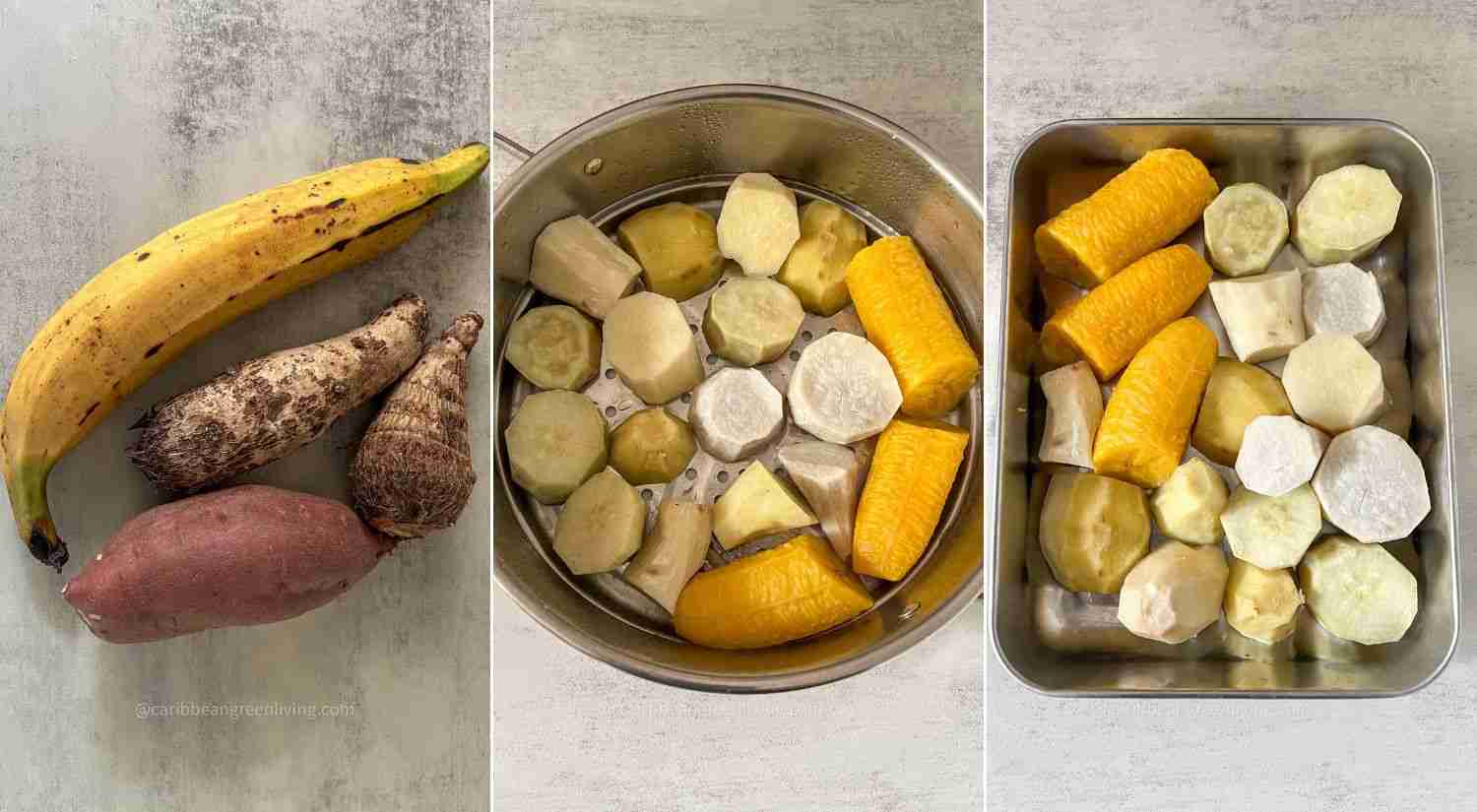
Steaming is another excellent method, and one I particularly like because it gives you more control over texture. I also prefer this method because if one vegetable cook faster it is easier to remove from the pan than if it boiling in water.
Dense provisions can be steamed until tender without becoming waterlogged.
Roasting
Roasting concentrates flavor and encourages browning around the edges.
Yams, sweet potatoes, potatoes, yuca, and ripe plantains can all benefit from roasting.
Frying
Plantains, potatoes, yuca, and other provisions can be fried for a crisp exterior and tender center.
Soups and Stews
This is where provisions really shine.
As they cook, some release starch into the broth, adding body while absorbing the flavors of herbs, aromatics, meat, seafood, and seasonings.
Haitian Bouillon is a perfect example.
How to Make a Simple Caribbean Provision Plate
You don’t need an elaborate recipe to enjoy ground provisions.
Choose two or three varieties for example:
- Yam
- Green plantain
- Sweet potato
- Malanga
- Yuca
Boil or steam them until tender, then serve alongside seasoned fish, chicken, meat, legumes, vegetables, or a flavorful sauce.
A mixture is often more interesting than serving only one because it gives you different textures and subtle flavor differences on the same plate.
It’s also an easy way to break the habit of serving rice with every meal. On another note, boil provisions are a must during lent period.
How to Store Ground Provisions
This is one area where you shouldn’t treat every provision the same way.
Potatoes and sweet potatoes
Keep whole, uncut potatoes and sweet potatoes in a cool, dry, dark, well-ventilated area away from direct sunlight.
Yams
Whole yams generally do well in a cool, dry, ventilated location. Once cut, refrigerate the unused portion and use it promptly.
Yuca
Fresh yuca is considerably more perishable than potatoes or yams. Buy it when you plan to use it rather than storing it for long periods.
You can also freeze peeled yuca for longer storage.
Malanga and yautia
Store whole roots in a cool, dry place for short-term use. Once peeled or cut, refrigerate them in a covered container and use promptly.
Plantains
Keep plantains at room temperature while they ripen. Their skins will naturally change from green to yellow and eventually develop dark spots as they become sweeter.
And remember: a refrigerator isn’t automatically good or bad for every provision. Storage depends on the particular crop and whether it is whole, peeled, cut, or cooked.
Can You Freeze Ground Provisions?
Yes, but preparation matters.
For longer storage, many provisions are better peeled and prepared before freezing rather than waiting until they’re beginning to spoil.
Depending on the vegetable and how you plan to use it, you can blanch, partially cook, or fully cook provisions before freezing.
You can also portion cooked provisions into freezer-safe containers for quick future meals.
Freezing is especially convenient if you regularly cook Caribbean food but don’t live close to a market that carries fresh tropical provisions.
You can read our how to freeze plantains guide to learn more.
Caribbean Ground Provisions FAQ
Are ground provisions the same as root vegetables?
Not exactly. Many ground provisions are roots, tubers, or corms, but Caribbean cooks may also group other starchy staples with provisions because they are prepared and served similarly. Plantains and breadfruit are good examples.
Are yams and sweet potatoes the same?
No. True yams and sweet potatoes are botanically different plants. Caribbean yams generally have a firmer, starchier texture than the orange sweet potatoes commonly sold in U.S. supermarkets.
Is plantain a root vegetable?
No. Plantain is a fruit, although green plantains are cooked and served more like a starchy vegetable. You will find green or yellow plantains. When green plantains ripen they become yellow and have a sweet taste.
Are malanga, yautia, and taro the same thing?
Not necessarily. The names vary considerably by country and market, and related tropical corms are sometimes mislabeled or grouped together. When possible, identify the specific variety you’re purchasing.
What are the easiest Caribbean provisions to try first?
If you’re new to them, start with green plantain, sweet potato, yuca, or yam. They’re versatile and work well with simple cooking methods such as boiling, steaming, roasting, and frying.
What can I serve with boiled provisions?
Serve them with stewed or roasted chicken, fish, beef, legumes, vegetables, or a flavorful sauce. They can replace rice, pasta, or potatoes in many meals.
Start Cooking with Caribbean Ground Provisions
Ground provisions aren’t trendy new ingredients in Caribbean cooking. They’ve been feeding Caribbean families for generations.
Yam, yuca, malanga, sweet potatoes, plantains, and other provisions are affordable, versatile ingredients that can turn a simple meal into something hearty and satisfying.
If you’re trying to cook more Caribbean food, or simply want alternatives to serving rice and pasta every day, learning how to buy, prepare, and cook provisions is a great place to start. Start with one you recognize, then try another.
Before long, that unfamiliar yam or malanga sitting in the international market won’t seem unfamiliar at all.
Source
- https://www.healthline.com/health/food-nutrition/plantain-nutrition-benefits#antioxidants
- https://www.healthline.com/nutrition/sweet-potato-benefits
Originally published February 4, 2022. Revised and updated.