Eggplant Guide: How to Choose, Prep, Cook & Use Eggplant in Caribbean Cooking
Eggplant is one of those vegetables that completely changes depending on how you cook it. Raw, it is firm and somewhat spongy. Once cooked, it becomes tender, creamy, and excellent at absorbing the flavors of herbs, spices, sauces, and other vegetables.
In Haitian and Caribbean kitchens, that quality makes eggplant especially useful. It can be sautéed as a simple side dish, simmered with tomatoes and other vegetables, roasted, grilled, fried, or incorporated into vegetable stews. Most importantly for Haitian cooking, eggplant is one of the vegetables commonly used in legim (légumes).
If you’ve ever wondered which eggplant to buy, whether you really need to peel or salt it, or why your eggplant seems to soak up every drop of oil in the pan, this eggplant guide will walk you through the basics—and show you how eggplant fits naturally into Haitian and Caribbean cooking.
What Is Eggplant?
Eggplant (Solanum melongena), also called aubergine, berejenn (Haitian Creole), or brinjal in different parts of the world, belongs to the nightshade family along with tomatoes, peppers, and potatoes.
Although we usually cook eggplant as a vegetable, botanically it is a fruit.
Eggplants come in many shapes, sizes, and colors. You may find large dark-purple eggplants at an American supermarket, long slender Asian varieties, small round eggplants, or striped and white varieties at farmers’ markets and specialty stores.

The flavor and texture vary slightly by variety, but most become soft and creamy when properly cooked.
Common Types of Eggplant
You don’t need a particular variety for most Caribbean recipes. Understanding the differences, however, can help you choose the best eggplant for the way you intend to cook it.
Globe or American Eggplant
This is the large, dark-purple eggplant most commonly found in U.S. supermarkets.
It has a substantial, meaty texture and works well for:
- Haitian legim
- vegetable stews
- roasting
- sautéing
- grilling
- frying
- baking
Because globe eggplants can become quite large, older ones may have tougher skin and more noticeable seeds.
Italian Eggplant
Italian eggplants resemble globe eggplants but are generally smaller.
Their tender flesh works well for sautéing, roasting, stewing, and grilling. They are also a good choice when you don’t need the quantity provided by a very large globe eggplant.
Japanese and Chinese Eggplant
These varieties are long and slender with relatively thin skins and tender flesh.
They cook quickly and are excellent for:
- stir-frying
- sautéing
- grilling
- roasting
- quick vegetable dishes
Their thin skin usually does not need to be peeled.
Graffiti or Striped Eggplant
These beautiful eggplants have purple-and-white striped skin. They can generally be prepared much like Italian or globe eggplant.
White Eggplant
White eggplants range from small, egg-shaped varieties to larger ones. Depending on the variety and maturity, their texture can range from delicate to fairly firm.
Good to know: Don’t get too caught up in finding the “perfect” variety. For Haitian legim and everyday Caribbean vegetable dishes, a fresh globe or Italian eggplant is usually an excellent place to start.
How to Choose a Good Eggplant
Freshness matters more than size.
Look for an eggplant that:
- feels firm for its size
- has smooth, glossy skin
- has a fresh-looking green stem and cap
- feels heavy rather than dried out or hollow
- has no major soft spots, cracks, or bruises
Gently press the skin with your finger. It should have some give but should not feel soft or mushy.
Avoid eggplants with deeply wrinkled or dull skin, extensive brown areas, or a dried-out stem. An older or overripe eggplant is also more likely to contain large seeds and develop bitterness.
Are Smaller Eggplants Better?
Not necessarily. Size depends partly on the variety. A large globe eggplant can be perfectly good if it is fresh.
Instead of judging only by size, pay attention to firmness, glossy skin, weight, and freshness of the stem.
How to Store Eggplant
Eggplant is surprisingly sensitive to temperature. For the best flavor and texture, buy it when you plan to cook it and use it within a few days.
If your kitchen is relatively cool and you’re using the eggplant quickly, keep it away from direct sunlight and heat.
For longer storage, place it in the refrigerator, preferably somewhere it won’t be exposed to excessive moisture or the coldest temperatures.
Avoid cutting eggplant until you’re ready to use it. Once cut, the exposed flesh begins to discolor fairly quickly.
If you have more eggplant than you can use, avoid freezing it raw. Uncooked eggplant tends to lose its texture and does not cook as well after freezing. For better results, blanch the eggplant before freezing, or cook it first and freeze it once cooled.
How to Freeze Eggplant
If you have more eggplant than you can use, avoid freezing it raw. Uncooked eggplant tends to lose its texture and does not cook as well after freezing. For better results, blanch it first or cook it before freezing.
To blanch and freeze eggplant:
- Wash the eggplant and trim off the stem.
- Peel it if desired, then cut it into slices, cubes, or the size you normally use for cooking.
- Bring a large pot of water to a boil. Adding a little lemon juice to the water can help reduce discoloration.
- Add the eggplant and blanch for about 3–4 minutes, working in batches if necessary.
- Immediately transfer the eggplant to a bowl of ice water to stop the cooking process.
- Drain thoroughly and pat dry to remove as much excess moisture as possible.
- Arrange the pieces in a single layer on a parchment-lined baking sheet and freeze until firm. This prevents them from freezing together in one large clump.
- Transfer the frozen eggplant to freezer-safe bags or airtight containers. Remove as much air as possible, label with the date, and return to the freezer.
For the best quality, use frozen blanched eggplant within about 6 months.
Freezing cooked eggplant: If you are planning to use the eggplant for Haitian legim, stews, sauces, or other dishes where a very firm texture isn’t necessary, cooking it before freezing is another good option. Let the cooked eggplant cool completely, then portion it into airtight, freezer-safe containers, label them, and freeze. For best quality, use within about 3 months.
Using frozen eggplant: For soups, stews, legim, and similar cooked dishes, you can usually add the frozen eggplant directly to the pot without thawing it first. Keep in mind that previously frozen eggplant will be softer than fresh eggplant, making it better suited to cooked dishes than recipes where a firm texture is important.
Do You Need to Peel Eggplant?
Usually, no. The skin of a fresh eggplant is edible and helps pieces maintain some structure during cooking.
There are times when peeling makes sense.
Consider peeling eggplant when:
- the eggplant is very large or mature
- the skin feels particularly thick or tough
- you want an especially smooth finished texture
- you’re making a dish in which you don’t want pieces of skin remaining
For Haitian legim, this can become a matter of personal and family preference. Because the vegetables are cooked until very tender and may be mashed or broken down, peeling can create a smoother final texture.
You can also compromise by peeling the eggplant in alternating strips. This removes some of the tougher skin while leaving enough to help the pieces hold their shape during cooking.
Do You Really Need to Salt Eggplant?
This is probably one of the most common questions about cooking eggplant. The short answer is: Not always.
Older recipes often instruct cooks to salt eggplant to remove bitterness. Modern eggplant varieties, particularly fresh and smaller eggplants, are often mild enough that salting solely for bitterness isn’t necessary.
But salting can still be useful.
Salt eggplant when:
- you’re using a large or mature globe eggplant
- you notice large seeds
- you’re concerned about bitterness
- you’re frying or sautéing and want to remove some moisture
- you want a firmer, less watery texture
How to salt eggplant
Cut the eggplant as directed in your recipe.
Sprinkle the pieces lightly with salt and place them in a colander.
Let them rest for approximately 20–30 minutes.
Rinse away excess salt if necessary and, most importantly, pat the eggplant thoroughly dry before cooking.
If the eggplant is young, firm, and fresh and you’re adding it directly to a stew such as legim, you can often skip this step.
Why Does Eggplant Absorb So Much Oil?
Anyone who has sautéed eggplant has probably experienced this:
You add oil. The eggplant absorbs it.
You add more oil. The eggplant seems to absorb that too.
Eggplant flesh has a porous, sponge-like structure, which is why it can soak up considerable amounts of oil during cooking.
That same characteristic is also one of eggplant’s strengths; it readily takes on the flavors surrounding it.
The goal isn’t to drown it in oil. It’s to control the cooking method.
How to Keep Eggplant From Becoming Greasy
1. Don’t keep adding oil
When the eggplant first absorbs the oil in the pan, resist the temptation to keep pouring more in. As the eggplant cooks and its structure begins to collapse, it will soften.
2. Salt it first when appropriate
Salting can remove some moisture and alter the texture, which can be useful when sautéing or frying.
3. Use a hot pan
Allow your pan to heat properly before adding the eggplant.
4. Don’t overcrowd the pan
Crowding traps steam. If you’re trying to brown eggplant, give the pieces enough room to make contact with the hot surface.
Cook in batches if necessary.
5. Brush rather than pour
For grilling or roasting eggplant slices, lightly brushing them with oil gives you much more control than pouring oil directly over them.
A pastry silicone brush will work best.
6. Roast instead of frying
Roasting is an easy way to develop browned edges and creamy flesh without using large amounts of oil.
How to Cut Eggplant
How you cut eggplant should depend on what you’re cooking.
Cubes: Best for vegetable stews, sautéed dishes, and dishes where eggplant is mixed with other vegetables.
Rounds: Good for sautéing, baking, grilling, and frying.
Lengthwise slices: Useful for grilling and roasting.
Large chunks: Particularly useful for long-cooked vegetable dishes where you don’t want the eggplant to disappear immediately.
For legim, don’t worry about creating picture-perfect pieces. The vegetables are ultimately cooked together until tender, and texture matters more than perfect knife cuts.

Best Ways to Cook Eggplant
Eggplant is one of the most versatile vegetables in the kitchen.
Sauté
Cubed or sliced eggplant can be cooked in a skillet with a modest amount of oil. This works especially well with garlic, onions, herbs, peppers, and tomatoes.
Don’t overcrowd your pan if you want browned edges instead of steamed eggplant.
Roast
Roasting concentrates the flavor while producing browned edges and a soft interior. Cut into cubes or slices, lightly coat with oil and seasonings, and spread in a single layer on a baking sheet.
Grill
Thick slices of eggplant hold up beautifully on the grill. Brush lightly with oil and season before grilling until tender with nicely browned edges.
Stew
This is where eggplant becomes especially interesting for Caribbean cooking.
When eggplant cooks slowly with other vegetables and seasonings, its flesh softens and begins to break down. Instead of remaining a completely separate component, it becomes part of the body of the dish.
That makes it particularly valuable in Haitian legim.
Fry
Eggplant can also be fried, but its tendency to absorb oil means preparation and oil temperature matter.
If frying, avoid letting the eggplant sit in oil that isn’t properly heated.
Eggplant in Haitian and Caribbean Cooking
Eggplant appears in different forms throughout Caribbean cooking, where it works naturally with the region’s abundant vegetables, aromatics, herbs, peppers, and savory seasonings.
Depending on the island, household, and recipe, eggplant may be:
- stewed with other vegetables
- sautéed with aromatics
- cooked with tomatoes
- combined with squash or zucchini
- served as a vegetable side
- roasted or grilled
- incorporated into meat and vegetable dishes
In Haitian cooking, one of its most important uses is in legim.


Why Eggplant Works So Well in Haitian Legim
This is where understanding the ingredient makes a noticeable difference.
Haitian legim is not simply a collection of vegetables placed together in a pot. The vegetables interact with one another to create the final texture and flavor of the dish.
And eggplant performs a particularly useful job.
Eggplant softens and helps create body
As eggplant cooks, its flesh becomes extremely tender and begins to collapse.
That softness contributes to the thick, cohesive texture associated with many versions of legim.
It absorbs the seasonings around it
Eggplant’s sponge-like flesh readily absorbs savory flavors.
In legim, that means it can take on the flavors of the meat or cooking liquid along with aromatics, herbs, peppers, and seasonings used in the pot.
Instead of competing with those flavors, eggplant helps carry them throughout the dish.
It works with firmer vegetables
Think about the different textures that can go into a pot of legim.
- Cabbage retains some structure.
- Carrots remain firmer.
- Chayote softens but doesn’t behave exactly like eggplant.
- Leafy greens wilt.
- Squash becomes tender.
Eggplant helps bridge those different textures because it breaks down and surrounds the firmer vegetables.
It helps create texture without relying on a separate thickener
This is one of the most useful things to understand about eggplant in legim.
Once thoroughly cooked and incorporated into the vegetables, eggplant naturally contributes body and creaminess to the mixture. That makes it more than just “another vegetable” in the pot.
Eggplant is a texture-building ingredient.
And that’s one reason it works so beautifully in Haitian legim.
Is There One Correct Vegetable Combination for Haitian Legim?
No—and that’s important.
Legim reflects the resourcefulness of Haitian cooking.
The exact vegetables can vary depending on availability, season, region, and family preferences. Eggplant may be combined with vegetables and greens such as:
- cabbage
- chayote (mirliton)
- carrots
- spinach
- watercress
- squash
- other leafy greens and vegetables
Some households use eggplant heavily. Others use less or adjust the vegetable combination based on what they have. Understanding that flexibility is more useful than treating legim as a recipe with one rigid vegetable list.
Personal note: I’ve started using Japanese or Chinese eggplant when making Haitian legim or eggplant stew. These varieties tend to have smaller, less noticeable seeds, which work better for my family. My sister is able to enjoy them, while some globe or Italian eggplants can develop larger, more noticeable seeds that may cause itching or discomfort in her mouth.

Flavor Pairings for Eggplant
Eggplant works especially well with many ingredients already common in a Caribbean kitchen.
Try it with:
- garlic
- onions
- scallions
- thyme
- parsley
- bell peppers
- hot peppers
- tomatoes
- tomato paste
- lemon or lime
- olive oil
- ginger
- savory spice blends
Because eggplant itself has a relatively mild flavor, the seasoning determines much of the personality of the finished dish.
What to Do If Your Eggplant Tastes Bitter
Fresh eggplant generally shouldn’t be intensely bitter. Bitterness is more likely with older or overripe eggplants.
If you cut into one and find large, developed seeds or suspect it may be bitter:
- Peel it if the skin is thick.
- Remove particularly large or mature seeds if necessary.
- Cut the eggplant.
- Salt it and allow it to rest for about 30 minutes.
- Rinse away the excess salt.
- Pat it thoroughly dry.
- Continue with your recipe.
Choosing a fresh eggplant in the first place is the easiest way to avoid the problem.
Common Eggplant Cooking Mistakes
Using too much oil
Eggplant can absorb oil quickly. Adding more every time the pan looks dry can leave you with greasy eggplant.
Crowding the pan
If you’re sautéing or browning eggplant, overcrowding causes it to steam.
Cutting pieces unevenly
Very small pieces can become mushy before larger pieces finish cooking.
Assuming every eggplant needs salting
It doesn’t. Let the age of the eggplant and the cooking method determine whether the extra step is worthwhile.
Peeling every eggplant automatically
Tender skin is perfectly edible. Peel when the variety, maturity, or finished dish calls for it.
Undercooking it
This may be the biggest mistake. Properly cooked eggplant should be tender. Half-cooked eggplant can be unpleasantly spongy and chewy.
For a stew or legim, give it enough time to soften and become part of the dish.
Eggplant Recipes to Try
Once you understand how eggplant behaves, it’s easy to use beyond legim.
Simple Sautéed Eggplant with Lemon-Infused Olive Oil
This simple preparation lets eggplant take center stage. Slices are lightly seasoned and sautéed until golden and tender.
It’s an easy side dish and a good recipe for learning how eggplant behaves in a skillet.

Eggplant, Zucchini and Fresh Tomato Vegetable Stew
Eggplant, zucchini, and fresh tomatoes cook together into an easy vegetable dish that’s particularly useful when summer produce is abundant.
The eggplant helps give the stew substance while absorbing the flavors of the other vegetables and seasonings.
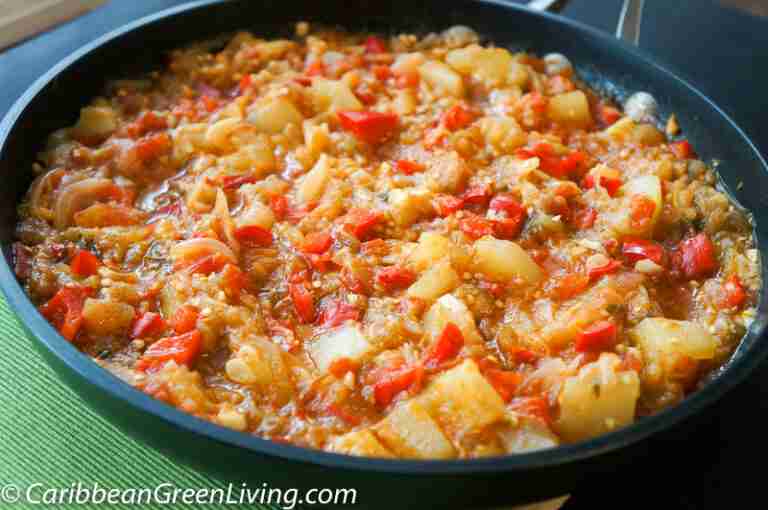
Haitian Legim
For an entirely different use of eggplant, explore Haitian legim and see how eggplant works alongside other vegetables to create the characteristic texture of this Haitian staple.

Frequently Asked Questions About Eggplant
Do you have to peel eggplant before cooking?
No. The skin is edible and can be left on when it is tender. Large or mature eggplants sometimes develop tougher skin, so peeling those may improve the final texture.
Do you have to salt eggplant?
No. Fresh modern varieties are often mild enough that salting isn’t required to remove bitterness. Salting can still be useful for older eggplants and certain cooking methods because it draws out moisture and changes the texture.
Why is my eggplant bitter?
The eggplant may be older or overripe. Look for fresh, firm eggplants with glossy skin and a fresh green cap. Salting an older eggplant before cooking can help reduce unwanted bitterness.
Why does eggplant absorb so much oil?
Eggplant has a porous interior that readily absorbs liquid and fat. Use controlled amounts of oil, cook at the appropriate temperature, and consider roasting or grilling when you want to use less oil.
Can you eat eggplant skin?
Yes. Eggplant skin is edible. Whether you keep it depends primarily on the variety, the eggplant’s maturity, and the texture you want in the finished dish.
What is the best eggplant for Haitian legim?
Large globe eggplant works very well and is widely available in U.S. supermarkets. Italian eggplant can also be used. Freshness matters more than finding one particular variety.
Why is eggplant used in Haitian legim?
Eggplant becomes extremely tender as it cooks, absorbs the surrounding seasonings, and helps create body in the vegetable mixture. Its texture makes it work particularly well with firmer vegetables such as cabbage, carrots, and chayote.
Can I make legim without eggplant?
Yes. Haitian legim varies considerably among families, regions, seasons, and available ingredients. Eggplant is a common and particularly useful ingredient, but it isn’t the only way to make legim.
A Vegetable Worth Understanding
Eggplant is much easier to cook once you understand what it does.
Its ability to absorb flavor can seem like a disadvantage when you’re watching it soak up oil in a skillet, but that same quality makes eggplant an excellent ingredient for deeply seasoned dishes.
And in Haitian cooking, its role in legim demonstrates exactly why knowledge of ingredients matters.
Eggplant doesn’t simply add another vegetable to the pot. It softens, absorbs seasoning, connects different textures, and helps build the body of the dish.
Once you understand that, you can make better decisions about when to peel it, when to salt it, how large to cut it, and how long to cook it—whether you’re making Haitian legim, a quick sautéed side dish, or a simple Caribbean-inspired vegetable stew.